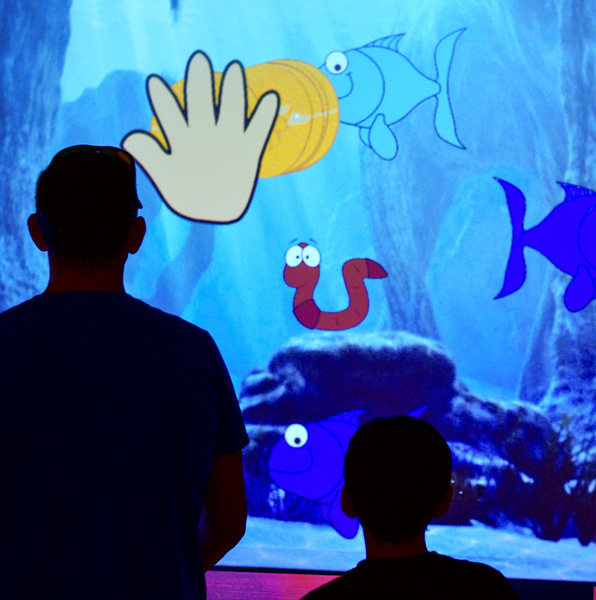
Just a few short days months ago, Kimotion was on
display at SPARKcon. SPARKcon is a large art festival in Raleigh, and we
occupy a small slice of it called geekSPARK.
#
Kimotion Levels Up
Last year’s tech had a rudimentary and finicky hand tracking system. It
was workable, but …
They say good developers are lazy. A tedious process is no match for a
lazy developer. Below is an experiment in laziness. It’s a proof of concept
for using Web Components without having to manually import each one.
I’m not sure exactly what to call it. It grazes the definitions …
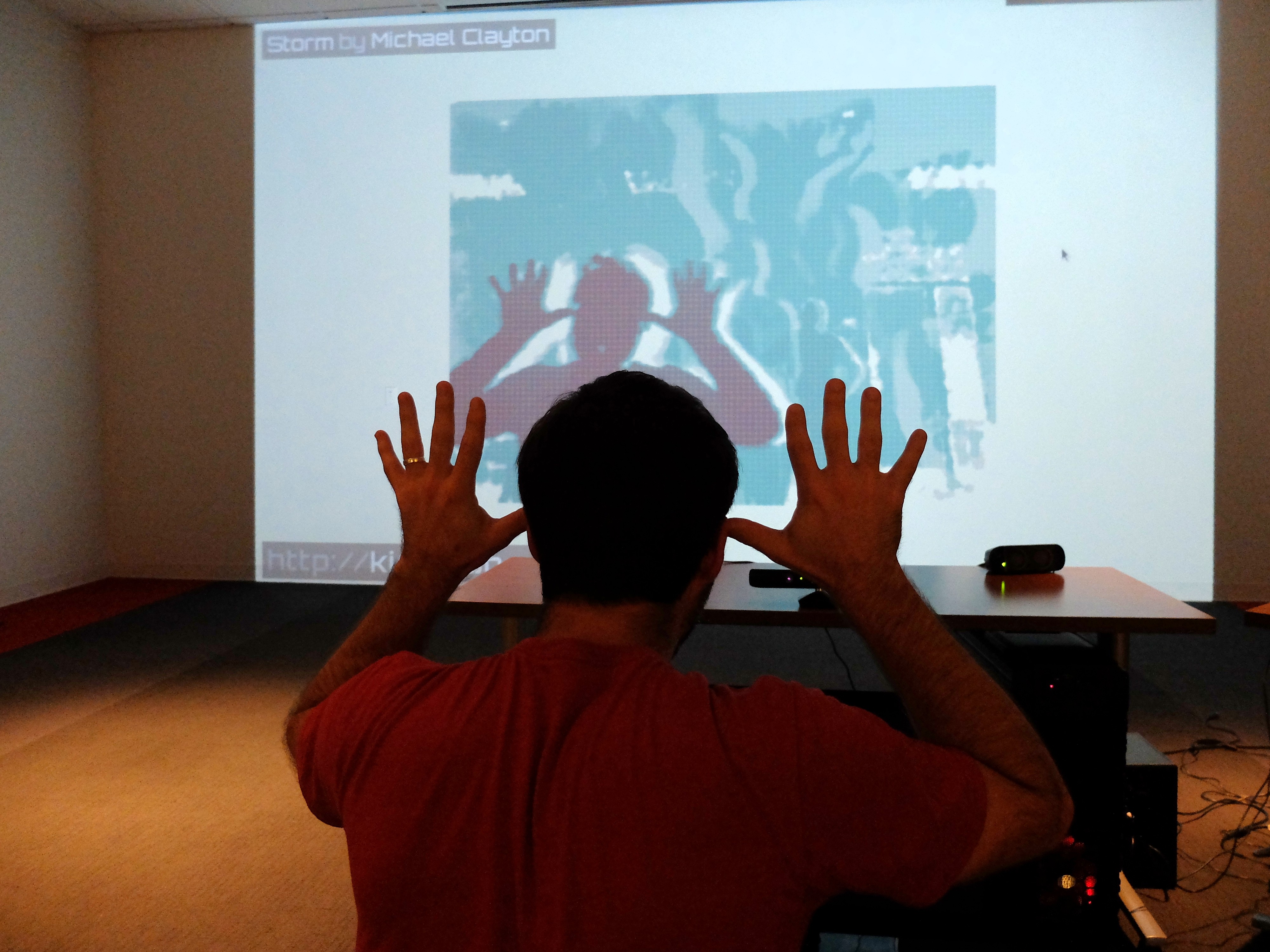
Kimotion is a simple framework for creating interactive art exhibits in 2D or
3D and supports both Kinect and Leap Motion for viewer input.
This tutorial will focus on the Leap, so to proceed with the tutorial you’ll
need to set up your Leap.
Once the leap service is running, you…
“Finally,” I thought, “an excuse to play with WebGL at work!”
This year, I had the good fortune of contributing to a keynote presentation at
Red Hat Summit. During the keynote, an audience of 5,000 played a
mobile web game created by our team. The game was backed by several
micro…
A year ago, I had the joy of working on Digital Motion, an interactive
art exhibit for Raleigh’s annual art festival, SPARKcon.
The month leading up to SPARKcon 2014 was a mad dash of perfecting the graphics
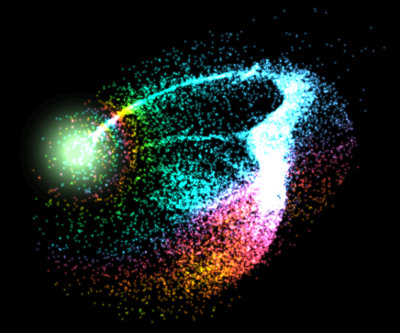
and physics equations of my DiMo: Particles display. After a
wonderful w…
In the midst of this beastly summer we’ve just entered, nothing seems farther
away than the lung-clenching air of winter. When things are this hot, and
pools and popsicles fail to cool, there’s one foolproof way to get into the
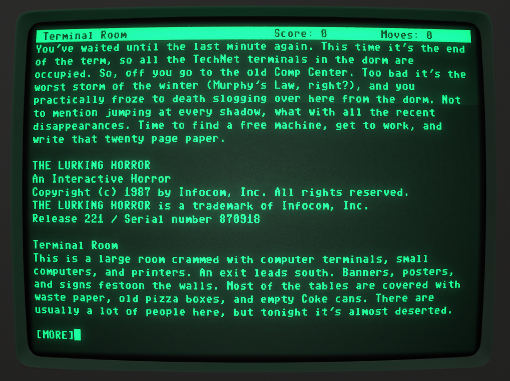
spirit of winter: The Lurking Horror.
… you practic…
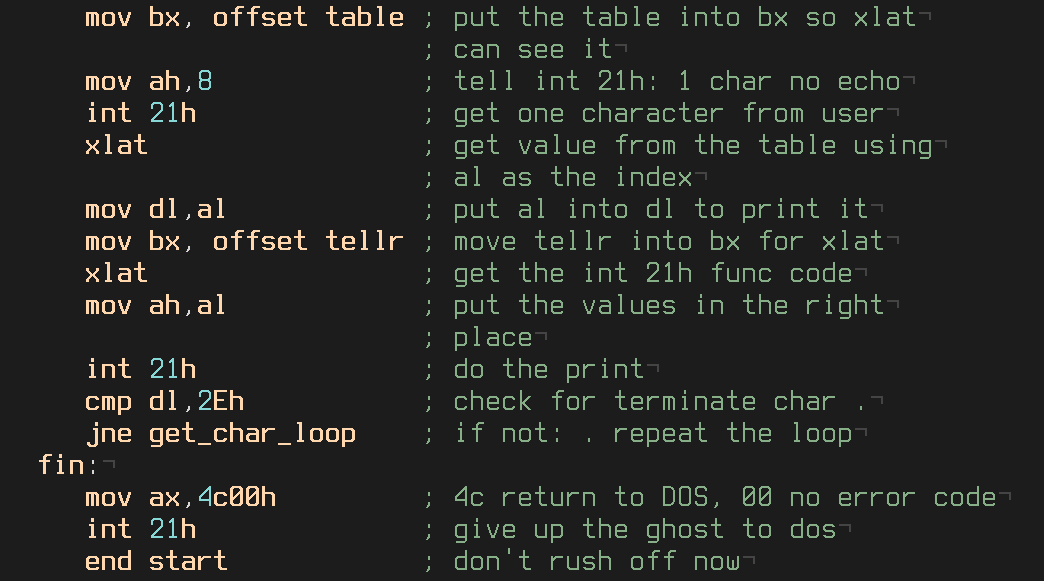
Within the last two days, WebAssembly (wasm) has graced the eyeballs of many JavaScript developers. If WebAssembly is new to you, the articles linked at the end of this post fully describe what WebAssembly is. In short, it offers a way to run native code in a Web browser.
I’d li…
There are only two hard problems in computer science: cache invalidation,
naming things, and off-by-one errors.
Phil Karlton, but I can't find a name for the original source...
Contriving names for things is so commonpla…
Imagine a solitary blue dot.
Unless you let your imagination run away with itself, this is going to be a
pretty boring dot. Now, imagine a second, larger dot (you can pick the color).
Red, nice choice! The scene is now slightly more interesting, since now you’ve
got two dots to…